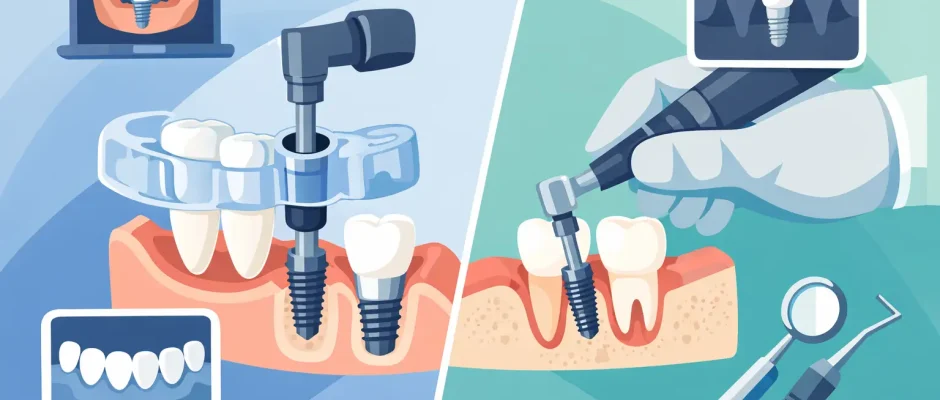
A dental implant is placed within millimeters of structures that matter: adjacent roots, the maxillary sinus, the inferior alveolar nerve, and the outer contours of the jaw. That is why the question of guided implants vs freehand placement is not about choosing a fashionable technique. It is about choosing the planning and surgical approach that gives a particular patient the safest, most prosthetically correct result.
A surgical guide can add an important level of control. Freehand placement remains a valuable technique in experienced hands. Neither option should be selected from a brochure or based solely on price. The right choice begins with a clinical examination, CBCT scan, assessment of bone volume and soft tissues, and a clear understanding of the future crown or bridge.
What guided implant placement means
Guided implant placement begins long before the day of surgery. A three-dimensional CBCT scan shows the available bone and the location of critical anatomical structures. When combined with an intraoral scan or a precise dental model, it allows the surgeon to plan the implant position in relation to the planned restoration.
A surgical guide, often called a template, is then produced from this digital plan. It rests on the teeth, gums, or bone and contains sleeves or guiding elements that help control the direction, position, and, in many systems, the depth of osteotomy preparation and implant insertion.
The key point is that the guide does not replace clinical judgment. It transfers a carefully made plan to the surgical field. The quality of the outcome therefore depends on the entire chain: accurate imaging, correct digital design, stable guide seating, appropriate implant system, and the surgeon’s ability to recognize when the clinical situation requires a change.
Why the prosthetic plan comes first
An implant is not an isolated screw in bone. It must support a crown, bridge, or full-arch restoration that is comfortable, cleansable, and able to receive chewing forces correctly. A digitally planned guide makes it easier to place the implant from the perspective of the final tooth position, rather than simply placing it where bone appears most abundant.
This is particularly valuable in the esthetic zone. Small deviations in angulation or depth can affect the emergence profile of the crown, the contour of the gum, and the visibility of metal components. For a front tooth, these details can be as important as successful bone integration.
When a surgical guide adds the most value
Guided surgery is often beneficial when anatomy leaves little room for error. In the posterior mandible, the distance from the implant site to the mandibular nerve may be limited. In the upper posterior jaw, the maxillary sinus can restrict available bone height. A guide helps translate a planned safe trajectory into the procedure.
It can also be useful for immediate implant placement after tooth extraction. The extraction socket does not always indicate the correct final implant position. The surgeon may need to engage native bone beyond or beside the socket while preserving a prosthetically favorable trajectory. Digital planning can clarify this path before surgery begins.
For full-arch treatment, including selected All-on-4 protocols, guides support coordination between surgical and restorative stages. Implant position, angulation, available restorative space, and the design of a provisional bridge must work together. This planning can reduce surprises when immediate provisionalization is intended.
Guides are also helpful in cases with limited bone, where the plan may involve sinus lift surgery, guided bone regeneration, or a carefully selected implant diameter and length. They do not eliminate the need for bone augmentation when augmentation is indicated. Their role is to make decisions more deliberate and execution more controlled.
Guided implants vs freehand placement: the real differences
The most visible difference is the level of preoperative transfer from the digital plan to surgery. With a fully guided protocol, the template can control drilling direction and depth and may guide implant insertion. In a pilot-guided protocol, the template directs the initial osteotomy, while later steps are completed manually. In freehand placement, the surgeon uses the CBCT plan, clinical landmarks, measurements, and direct surgical assessment without a physical template directing the drill.
Guided placement can improve positional accuracy compared with conventional freehand placement in appropriate cases. It may make surgery more efficient, reduce the need for extensive flap reflection in selected patients, and support a minimally invasive approach. Less surgical trauma can mean less postoperative swelling and discomfort, although recovery also depends on the extraction, bone grafting, individual healing, and the extent of surgery.
Freehand placement offers a different advantage: flexibility. Bone quality, soft tissue thickness, the shape of an extraction socket, and guide stability are assessed in real time. If the surgical site differs from the scan or a guide does not seat exactly as verified, the surgeon must be able to pause, reassess, and proceed safely. This is not a failure of digital technology. It is responsible surgery.
An experienced implant surgeon may choose freehand placement for a straightforward single-tooth case with favorable bone and clear anatomical margins. It can also be necessary when a guide cannot be reliably supported, when intraoperative findings require a different approach, or when regenerative procedures make the final implant position dependent on direct surgical assessment.
A guide is precise, but not automatic
Patients sometimes hear “computer-guided” and assume that the procedure is fully automated. It is not. Every guide has a tolerance. Even small deviations can occur because of scan quality, digital planning choices, printing accuracy, sleeve design, movement of a tooth-supported guide, or changes in soft tissue.
For this reason, a safe guided protocol includes verification. The guide must be tested for stable seating before drilling. The surgeon checks the clinical situation throughout the procedure and does not continue mechanically if the guide position is uncertain. Digital planning is a powerful safety tool when it is paired with disciplined surgical protocols.
The same principle applies to immediate loading. A guide may help place implants in the planned positions, but the decision to deliver a fixed temporary bridge depends on primary stability, implant distribution, bite forces, bone quality, and the patient’s ability to follow postoperative instructions. A template alone cannot guarantee immediate loading.
How the decision is made for your case
The decision should be individualized after diagnosis, not made as a standard package. During implant planning, the surgeon evaluates the quality and quantity of bone, distance to anatomical structures, gum thickness and smile line, condition of neighboring teeth, bite, oral hygiene, and the design of the final restoration.
A guided approach is often recommended when precision has a direct impact on safety, esthetics, or a complex restorative plan. Freehand placement may be entirely appropriate when anatomy is favorable and direct surgical control offers the most reliable result. In many treatments, the best approach is hybrid: detailed digital planning, a surgical guide for key steps, and careful manual decisions during surgery.
Patients should also understand that the guide is only one element of treatment. A predictable implant result may require atraumatic tooth extraction, preservation or reconstruction of bone, use of PRF where clinically appropriate, tension-free closure, and structured follow-up. The surgical plan should explain what is included and why each stage is necessary.
Questions worth asking before implant surgery
Rather than asking only whether the implant will be guided, ask how your implant position will be planned relative to the final crown or bridge. Ask whether a CBCT scan is needed, how close the site is to the sinus or nerve, whether bone grafting is expected, and what the backup plan is if intraoperative findings differ from the scan.
It is also reasonable to ask whether immediate placement or immediate loading is suitable in your situation. These options can be excellent when indications are met, but they should not be used merely to shorten the treatment timeline. Biology and stability still set the limits.
At Implantolog.co.il, digital planning and surgical templates are used when they improve control and predictability, not as a one-size-fits-all label. The goal is a treatment plan that protects anatomy, respects the conditions of your bone and gums, and supports a restoration that functions comfortably for years.
The best implant procedure is the one that remains precise when the scan becomes surgery – with technology providing guidance and an experienced surgeon responsible for every decision.


