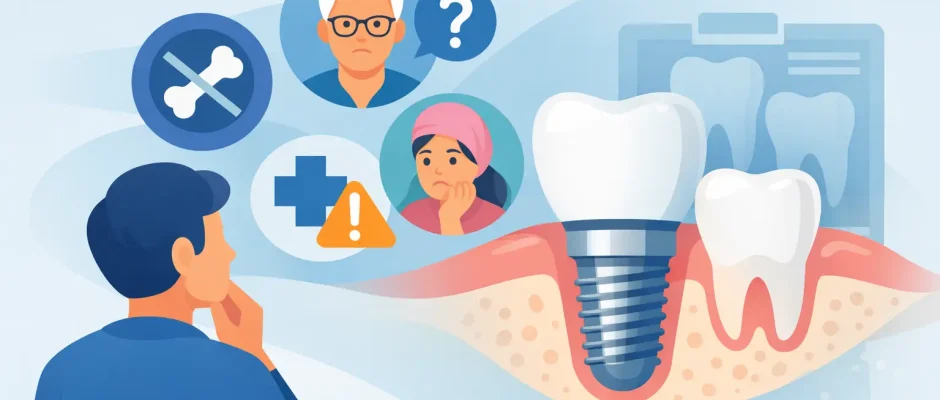
A missing tooth can affect chewing, speech, appearance, and confidence. Dental implants are often the most stable way to replace it, but the right question is not simply whether an implant can be placed. It is who is not a candidate for dental implants right now, and what must be addressed before surgery to make treatment safe and predictable.
For most adults, age alone, a history of tooth loss, or even reduced bone volume do not automatically rule out implant treatment. The decision depends on the condition of the gums and bone, general health, medications, bite forces, and the patient’s ability to follow the treatment and maintenance plan. A careful evaluation prevents unnecessary risk and helps avoid compromises that can shorten the life of an implant.
Who Is Not a Candidate for Dental Implants at This Time?
Very few patients are permanently excluded from implant treatment. More often, there are temporary contraindications or conditions that need to be stabilized first. Placing an implant before these factors are controlled can increase the risk of infection, failed integration with the bone, or inflammation around the implant later.
Active gum disease or untreated oral infection
An implant should not be placed into an environment with active infection. Advanced periodontitis, untreated abscesses, drainage from a tooth, or uncontrolled inflammation around neighboring teeth raise the bacterial burden in the mouth and may compromise healing.
This does not mean that a patient with a history of gum disease can never receive implants. It means periodontal treatment comes first. Professional hygiene, treatment of infected teeth, management of gum pockets, and a stable home-care routine are part of preparing for predictable implant treatment. Long-term maintenance is especially important because patients who have had periodontitis remain at higher risk for peri-implant inflammation.
Uncontrolled diabetes and serious systemic conditions
Diabetes is not an automatic reason to avoid implants. Many patients with well-controlled diabetes heal successfully. The concern is uncontrolled blood sugar, which can impair wound healing and make infection more likely. The surgeon may request recent medical information and coordinate timing or precautions with the patient’s physician when needed.
The same principle applies to serious cardiovascular disease, uncontrolled hypertension, significant immune suppression, severe liver or kidney disease, and conditions that affect blood clotting. Surgery may need to be postponed, modified, or performed only after medical stabilization. A complete medical history is not paperwork. It is a safety measure that guides anesthesia, antibiotic decisions, surgical technique, and postoperative monitoring.
Recent cancer treatment or high-risk bone medications
Patients receiving chemotherapy, high-dose radiation therapy to the jaws, or certain medications that affect bone metabolism require a particularly cautious approach. Drugs such as intravenous bisphosphonates and some antiresorptive or antiangiogenic medications may be associated with medication-related osteonecrosis of the jaw, a rare but serious healing complication.
The risk is not identical for every medication, dose, or patient. A person taking a low-dose oral medication for osteoporosis is evaluated differently from a patient receiving intravenous therapy for metastatic cancer. Implant treatment in these situations requires an individualized risk assessment, consultation with the treating physician when appropriate, and an honest discussion about alternatives.
Heavy smoking or nicotine use without readiness to change
Nicotine reduces blood flow to healing tissues and is associated with a higher risk of early implant failure, wound complications, and peri-implant disease. Cigarettes are not the only concern. Vaping, heated tobacco products, and other nicotine delivery systems can also affect healing.
Smoking does not always make implant treatment impossible, but it changes the risk profile. A patient who smokes heavily and is unwilling to reduce or stop nicotine use during the healing period may not be an appropriate candidate at that moment. A conservative plan, clear informed consent, and support for smoking cessation are more responsible than pretending the risk does not exist.
Inability to maintain oral hygiene and follow-up care
Implants cannot develop cavities, but they can lose supporting bone because of plaque-related inflammation. Daily brushing, cleaning between teeth or around implant restorations, and regular professional maintenance are essential. An implant is a long-term medical restoration, not a one-time procedure that can be forgotten after the crown is placed.
Patients who cannot currently maintain basic oral hygiene, repeatedly miss follow-up visits, or have untreated conditions that limit cooperation may need another solution first. This is not a judgment. It is a practical assessment of whether the treatment can succeed over years, rather than only on the day of surgery.
Severe bruxism without protection or bite control
Clenching and grinding can place excessive forces on implants, restorations, screws, and surrounding bone. Bruxism does not automatically disqualify a patient, but it must be recognized before treatment. In some cases, the plan includes a stronger restoration design, careful bite adjustment, multiple implants to distribute load, and a protective night guard.
When severe grinding is uncontrolled and a patient will not use protection, the chance of mechanical complications rises. Fractured ceramic, loosening screws, and overload of the implant system are not inevitable, but they are more likely when bite forces are ignored.
Lack of Bone Does Not Usually Mean “No”
A common misconception is that bone loss makes dental implants impossible. Bone volume matters because implants need stable support, but modern implant dentistry offers several ways to manage deficiency. Depending on the location and extent of bone loss, treatment may involve guided bone regeneration, bone grafting, sinus lifting in the upper jaw, shorter or angled implants, or a staged treatment plan.
The correct option depends on three-dimensional imaging, gum thickness, the position of nearby nerves and sinuses, the planned restoration, and the patient’s medical profile. In complex cases, digital planning and a surgical guide can improve the accuracy of implant positioning. PRF may also be used when clinically indicated to support soft-tissue and bone healing.
The key distinction is between a difficult case and an unsuitable case. Bone deficiency often makes treatment more complex, longer, and more expensive, but it is not automatically a contraindication. A plan should never promise grafting or immediate implantation before diagnostic imaging confirms that it is appropriate.
Situations That May Require a Different Solution
Sometimes an implant is technically possible but not the best first choice. If a tooth can be predictably preserved through root canal treatment, periodontal therapy, or microsurgical treatment, saving the natural tooth may be preferable. Implant treatment is an excellent replacement option, not a reason to remove a tooth that has a realistic long-term prognosis.
An implant may also be less suitable when space is inadequate, the planned crown would be excessively large, or the patient has unrealistic expectations about timing, appearance, or maintenance. Immediate implantation after extraction can be an excellent protocol in selected cases, but it is not appropriate for every infected tooth socket, bone defect, or esthetic zone.
For patients missing all teeth, fixed full-arch options such as All-on-4 can be considered, but they still require adequate diagnosis of bone anatomy, bite, hygiene ability, and medical risks. A fixed solution is not automatically better than a removable one if it makes hygiene difficult or creates unnecessary surgical risk.
How Candidacy Is Determined Safely
A reliable implant consultation includes more than a quick look at the missing tooth. The evaluation should review medical history and medications, examine the gums and bite, assess oral hygiene, and use appropriate imaging to evaluate bone and anatomical structures. The final restoration should be considered before surgery, because implant position must support a functional and natural-looking tooth, not merely fill a space in the bone.
For patients with anxiety about surgery, a structured plan is often as reassuring as the procedure itself. Knowing why a particular implant position is chosen, whether grafting is needed, what healing will involve, and how follow-up is organized turns uncertainty into informed decisions.
A patient may not be ready for dental implants today and still become an excellent candidate after treating inflammation, improving glycemic control, stopping nicotine use, rebuilding bone, or stabilizing the bite. The safest plan is not the fastest one. It is the plan that gives the implant and the surrounding tissues the best chance to remain healthy for many years.


