A missing tooth is not only a cosmetic concern. Over time, the teeth beside the space may tilt, the opposing tooth can move downward or upward, and chewing forces become uneven. When deciding between a single implant or dental bridge, the key question is not simply which option is faster or less expensive today. It is which treatment preserves the healthiest tissues and gives a stable result for your specific bite, bone volume, and long-term needs.
Both options can restore chewing and appearance very successfully. The right choice begins with a clinical examination, digital imaging, and a treatment plan that accounts for the condition of the neighboring teeth – not only the gap itself.
Single implant or dental bridge: the essential difference
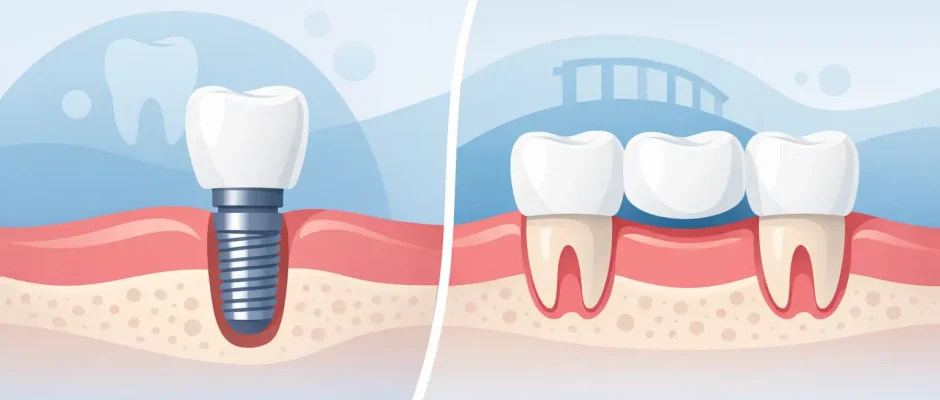
A single dental implant replaces the missing root with a titanium implant placed in the jawbone. After integration with the bone, the implant supports an individual crown. The adjacent natural teeth are not used as supports and, in many cases, do not need to be prepared.
A conventional dental bridge fills the gap with a replacement tooth connected to crowns on the teeth on either side. To place it, the supporting teeth are shaped to receive crowns. There are other bridge designs, but a traditional fixed bridge remains the most common approach for a single missing tooth.
The distinction matters because an implant treats the missing tooth as an independent unit, while a bridge relies on neighboring teeth. Neither principle is automatically better. The condition of those neighboring teeth often determines the appropriate solution.
When a single implant is usually the stronger option
An implant is often preferred when the teeth next to the missing tooth are healthy, intact, and free of large fillings or crowns. Preparing healthy enamel to support a bridge is irreversible. An implant can restore the gap without involving those teeth.
Implants also help preserve bone in the area of the missing root. After extraction, the jawbone naturally tends to shrink because it no longer receives functional stimulation. An implant does not stop every dimensional change, especially if bone loss has already occurred, but it provides stimulation inside the bone and can support a more stable contour over time.
Cleaning is another practical benefit. A single implant crown is brushed much like a natural tooth, with additional attention to the gumline and spaces between teeth. There is no connected pontic, the artificial tooth in the middle of a bridge, under which food and plaque can accumulate.
For patients missing a front tooth, an implant can also offer an excellent esthetic result when it is planned precisely. The position of the implant, thickness of the gum tissue, bone level, smile line, and shape of the final crown all matter. In the esthetic zone, placing an implant too far toward the lip or palate can compromise the final appearance even if it integrates successfully. Digital planning and, when indicated, a surgical guide improve control over implant position.
Immediate implant placement is not always appropriate
Some teeth can be extracted and replaced with an implant during the same surgical appointment. This may shorten the overall process and reduce the number of procedures. However, immediate placement is a protocol selected for suitable anatomy and infection control, not a shortcut to apply in every case.
The integrity of the socket walls, gum thickness, bone volume, bite forces, and ability to achieve primary implant stability must be evaluated first. In other situations, healing after extraction, bone grafting, or staged implantation creates a safer and more predictable foundation.
When a dental bridge may be the sensible choice
A bridge can be an appropriate and efficient solution when the adjacent teeth already have large restorations, significant fractures, root canal treatment, or crowns that need replacement. If those teeth require full coverage anyway, using them to support a bridge may avoid an additional surgical procedure.
A bridge may also suit a patient who cannot undergo implant surgery because of an uncontrolled medical condition, certain medication-related risks, or limitations that make surgery unsuitable. These decisions require coordination with the patient’s physician when necessary.
Time can matter as well. A conventional bridge is often completed more quickly than an implant restoration because implant treatment includes a healing phase. The exact timeline varies according to implant stability, bone grafting requirements, and the location in the mouth. A bridge may be particularly practical when a patient needs to restore function within a limited period and the supporting teeth have a clear restorative indication.
That said, a bridge is not maintenance-free. It requires careful daily cleaning beneath the replacement tooth, typically with floss threaders, interdental brushes, or a water flosser as advised. Decay or gum disease around one supporting tooth can affect the entire restoration.
The condition of neighboring teeth changes the answer
This is often the decisive part of the consultation. If two neighboring teeth are healthy and untouched, preserving them with an implant-supported crown is commonly the more conservative approach. If both already need crowns, a bridge deserves serious consideration.
The situation becomes more complex when only one neighboring tooth is weak or when the missing tooth is at the end of the dental arch. A cantilever bridge, supported on one side, can be used in carefully selected cases, usually where biting forces are low. It is not a universal solution for back teeth, where forces can be substantial.
The quality of the supporting teeth matters just as much as their appearance. A tooth with a short root, advanced bone loss, mobility, recurrent decay, or a questionable root canal prognosis may be a poor bridge abutment. Connecting a replacement tooth to a compromised support can transfer more load to a tooth that already has a limited prognosis.
Bone volume, gum health, and bite are not minor details
An implant requires adequate bone in three dimensions and healthy or treatable gum tissues. When bone is insufficient, treatment may still be possible with guided bone regeneration, sinus lift surgery in the upper posterior jaw, or other augmentation procedures. These procedures can make implant placement predictable in complex cases, but they add healing time, cost, and surgical steps.
A bridge does not require bone grafting, but it does not address bone deficiency beneath the missing tooth either. Where bone and gum contour are visibly reduced, especially in the front of the mouth, achieving a natural-looking result with any restoration becomes more challenging.
Bite analysis is equally important. Clenching, grinding, a deep bite, or limited space between the upper and lower teeth can increase mechanical risk for both implants and bridges. An implant has no periodontal ligament, the natural shock-absorbing structure around a tooth root. For this reason, crown design, contacts with opposing teeth, and sometimes a protective night guard should be considered carefully.
Comparing treatment timelines and long-term maintenance
A bridge can often be prepared and delivered over a shorter period, provided the supporting teeth and gums are stable. An implant may require several months from extraction to final crown, particularly when grafting or staged healing is needed. Provisional restorations can often maintain appearance during this period, but the plan should be discussed before treatment begins.
Long-term success depends less on choosing a fashionable option and more on maintenance. Implant crowns require professional monitoring for gum inflammation, bone changes, and mechanical issues such as screw loosening or ceramic chipping. Bridges require monitoring of crown margins, supporting teeth, and the area beneath the pontic where plaque can accumulate.
Neither restoration is immune to complications. Implant treatment can involve failed integration, peri-implant inflammation, esthetic tissue changes, or the need for bone augmentation. Bridges can develop decay beneath crowns, fracture, lose retention, or require replacement if a supporting tooth fails. A transparent plan includes these possibilities from the start.
How the decision should be made
A proper decision is based on a clinical and radiographic assessment, often including a 3D CBCT scan when implant treatment is being considered. The examination should evaluate the extraction site, bone anatomy, sinus or nerve position, periodontal condition, neighboring teeth, bite, smile line, and general health.
At Implantolog.co.il, surgical planning is approached as part of the final restorative result. The goal is not merely to place an implant, but to place it in a position that allows the restorative dentist to create a functional, cleanable, and natural-looking crown. When needed, digital planning, surgical guides, bone regeneration protocols, and PRF are selected according to the clinical situation.
A useful question to bring to your consultation is: what happens to the healthy teeth and bone if I choose each option? The answer usually makes the trade-off clearer than a price comparison alone.
The best restoration is the one that respects your biology, protects the teeth worth saving, and gives you a result you can maintain comfortably for years.


