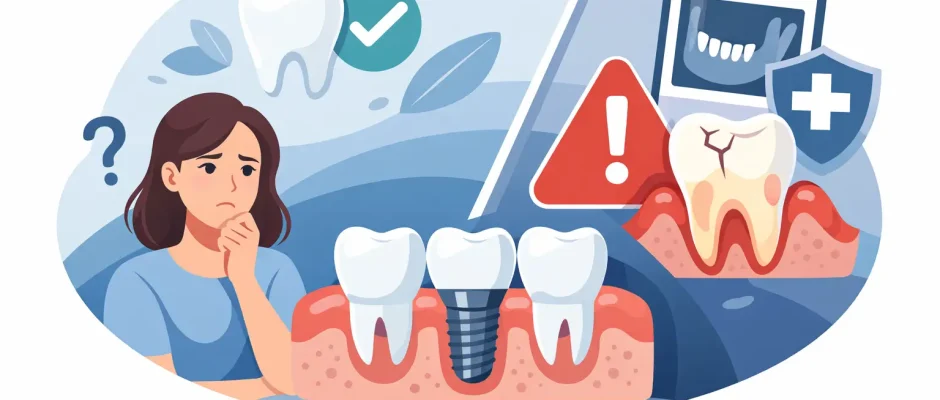
A missing tooth can affect eating, speech, confidence, and the stability of neighboring teeth. But the right question is not simply whether implants are possible. It is when you should not get dental implants – at least not yet. In many cases, a delay is not a refusal of treatment. It is the step that makes a future implant safer, more comfortable, and more likely to last.
A dental implant needs healthy tissue, sufficient blood supply, controlled biting forces, and a patient who can maintain the result over time. Modern digital planning, surgical guides, bone regeneration, and PRF protocols allow us to treat many complex situations. They do not eliminate the need for careful diagnosis.
When You Should Not Get Dental Implants Immediately
There is active infection that has not been treated
Pain, swelling, a draining fistula, untreated periodontal disease, or inflammation around a failing tooth can change the treatment sequence. Sometimes an infected tooth can be removed and replaced immediately with an implant. In other cases, the socket needs time to heal before implantation.
The decision depends on the type and extent of infection, the condition of the surrounding bone and gums, the possibility of achieving primary implant stability, and the planned final restoration. Immediate implantation can be an excellent protocol when its conditions are present. It should not be used simply because it is faster.
Advanced gum disease deserves special attention. If periodontitis remains active, the bacteria and inflammation that damaged the natural teeth can also threaten implants. Periodontal treatment, professional hygiene, and stable home care usually come before implant surgery.
Your diabetes or another chronic condition is poorly controlled
Diabetes does not automatically rule out dental implants. Many patients with diabetes receive successful implant treatment. The relevant issue is metabolic control. Persistently high blood glucose can impair wound healing, increase the risk of infection, and affect bone integration around the implant.
The same principle applies to conditions that affect immunity or healing. Certain autoimmune diseases, severe anemia, uncontrolled thyroid disease, significant kidney or liver disease, and active cancer treatment may require coordination with the treating physician and a modified surgical plan. Sometimes treatment proceeds safely with precautions. Sometimes it is wiser to wait until the medical condition is stable.
A responsible implant plan includes a detailed medical history, medication review, and, when indicated, current laboratory values or medical clearance. This is not bureaucracy. It is part of surgical safety.
You are receiving medications that affect bone metabolism
Antiresorptive medications, including some bisphosphonates and denosumab, are prescribed for osteoporosis and cancer-related bone disease. These medications can be associated with medication-related osteonecrosis of the jaw, particularly after invasive oral surgery. The level of risk varies substantially depending on the medication, dose, route of administration, duration of therapy, and overall health.
Do not stop prescribed medication on your own. Instead, the implant surgeon should review the treatment history and, when necessary, communicate with the physician managing your bone health or oncology care. In some situations, an implant is reasonable. In others, a removable or fixed non-implant alternative may be safer.
You smoke heavily and are not ready to change the habit
Smoking reduces blood flow to the gums and bone, compromises healing, and increases the risk of early implant failure and peri-implantitis. Heavy smoking is not always an absolute contraindication, but it is a meaningful risk factor that should be discussed openly.
The same applies to vaping nicotine. The delivery method differs, but nicotine can still impair tissue healing. Reducing or stopping nicotine use before surgery and during the healing period can improve the prognosis. If stopping is not realistic right now, it may be better to postpone elective implant surgery rather than proceed with expectations that do not match the clinical risk.
Severe teeth grinding has not been addressed
Implants do not have the same natural shock absorption system as teeth. A patient with uncontrolled bruxism may overload an implant, loosen a restoration screw, fracture ceramic, or damage the supporting bone over time.
Grinding does not mean implants are impossible. It means the restoration must be designed for the forces involved. This may include adjusting the bite, choosing an appropriate implant number and position, avoiding excessively long cantilevers, using durable restorative materials, and wearing a night guard. Placing an implant before addressing severe overload is an avoidable compromise.
Insufficient Bone Does Not Always Mean “No”
One of the most common reasons patients believe they cannot have implants is bone loss after tooth extraction. Bone volume can decrease over time, and the upper posterior jaw may also be limited by the maxillary sinus. A basic implant placed without adequate bone support may fail or create unnecessary risk to adjacent anatomical structures.
Still, bone deficiency is often a planning issue, not a permanent barrier. Guided bone regeneration, bone grafting, sinus lift procedures, short implants in selected cases, or a different implant position may be considered. Digital imaging helps assess bone volume and density, nerve location, sinus anatomy, and the prosthetic position of the future tooth.
There are limits. Extensive reconstruction may not be the best choice for every patient, especially when medical risks, treatment time, cost, or long-term maintenance outweigh the expected benefit. A predictable plan is not always the most extensive plan.
When Expectations Do Not Match the Biology
Implant treatment is a partnership. The surgery itself may take a short time, but the process includes healing, restoration, hygiene, and long-term follow-up. A patient who expects a permanent tooth with no maintenance may be disappointed and at higher risk of complications.
Implants can develop inflammation around them. Peri-implant mucositis and peri-implantitis are more likely when plaque control is poor, periodontal disease is untreated, smoking continues, or maintenance visits are skipped. An implant-supported crown also needs professional monitoring, just like a natural tooth needs examinations.
For a full-arch restoration such as All-on-4, the commitment is even more significant. The treatment can be life-changing for the right patient, but it requires proper planning, adequate hygiene access, a stable bite, and regular care. It should never be presented as a quick replacement for careful diagnosis.
Pregnancy and Other Reasons to Wait
Pregnancy is generally a reason to defer elective implant surgery. Urgent dental problems should still be treated, but implant placement, bone grafting, and elective sedation can usually wait until after delivery. This avoids unnecessary medications, stress, and procedural complexity during pregnancy.
A recent heart attack, stroke, major surgery, or unstable cardiovascular condition may also require postponement. The appropriate waiting period is individualized and should be decided with the relevant medical specialist. Acute illness, fever, or uncontrolled oral infection may likewise mean that a planned procedure should be rescheduled.
The key distinction is between an implant that is impossible and an implant that is poorly timed. Timing is a clinical decision, not a sales decision.
A Proper Assessment Comes Before the Implant
Before recommending treatment, an implant surgeon should evaluate the whole situation: your health history, medications, gum condition, bite, hygiene habits, missing-tooth site, and the appearance and function expected from the final restoration. Three-dimensional imaging is often essential for safe planning, particularly in areas close to the sinus or mandibular nerve.
The plan may include extraction, ridge preservation, periodontal treatment, temporary tooth replacement, bone regeneration, implant placement, and a final crown or bridge. Not every patient needs every stage. Explaining why a step is included – or why it can be avoided – is part of informed care.
At Implantolog.co.il, complex cases are planned with a focus on surgical safety, comfort, and the final prosthetic result rather than implant placement alone. A surgical guide, microsurgical technique, and biologic adjuncts such as PRF can be useful tools when they serve a clear clinical purpose.
If you have been told that implants are impossible, or if you are being encouraged to place them immediately without a full assessment, seek a careful second evaluation. The best time for an implant is when the tissues, health, and treatment plan are ready – not simply when the space in the mouth is empty.


